Heel Pain When Running: Causes and What to Do
Heel pain when running is not a single condition. It may be plantar fasciitis, Achilles tendinopathy, a heel spur, a calcaneal stress fracture, heel fat pad atrophy, or Sever’s disease in young runners. Because these conditions are treated differently, the first step is to identify where and when it hurts. Below is a quick guide to the possible causes, warning signs you should not ignore, and an honest look at what may help, including training load, footwear, and insoles.
Where does it hurt? A quick guide to possible causes
The location, timing, and pattern of pain can provide useful information even before you see a doctor. The table below is a starting point for guidance, not a diagnosis.
| Where and when it hurts | Most likely cause |
|---|---|
| Under the heel, worst with the first steps in the morning or after rest | Plantar fasciitis |
| At the back of the heel, where the Achilles tendon attaches to the heel bone | Insertional Achilles tendinopathy |
| Sharp, localized pressure under the heel with long-term inflammation of the fascia | Heel spur |
| A deep, dull pain that worsens during a run and does not ease after warming up | Calcaneal stress fracture, a warning sign |
| A deep “bruised” feeling in the center of the heel, often in older runners or those who run very high mileage | Heel fat pad atrophy |
| Heel pain in a child or adolescent during a growth phase, especially after training | Sever’s disease (calcaneal apophysitis) |
Plantar fasciitis and Achilles tendinopathy: the most common causes
Plantar fasciitis is by far the most common cause of pain under the heel in runners. According to StatPearls (NIH) , it affects about 10% of people at least once in their lifetime and causes sharp pain with the first steps after rest. Because this is a substantial topic in its own right, we have covered it in a separate article: Plantar Fasciitis: Causes, Symptoms, and Treatment. For specific exercises that may support recovery, see 5 Exercises for Plantar Fasciitis.
If your pain is at the back of the heel where the Achilles tendon attaches to the heel bone, the likely cause is insertional Achilles tendinopathy, often following a sudden increase in running intensity. Typical features include morning stiffness and pain that worsens at the beginning of a run. We cover the causes, self-care, and when to seek professional care in detail in the article Achilles Tendon Pain: Causes and Effective Relief for Athletes.
Another condition that is often mentioned is a heel spur , a bony growth on the heel bone that is not usually painful by itself. Pain comes from inflamed tissue around it, through the same mechanism involved in plantar fasciitis. Learn more in the article Heel Spur (Calcaneal Spur): Causes, Symptoms, and Treatment. If your heel hurts most in the morning even when you do not run, see also Morning Heel Pain: Causes and What You Can Do.
Calcaneal stress fracture: a warning sign you should not ignore
Unlike plantar fasciitis, which often eases slightly during a run, pain from a calcaneal stress fracture gradually worsens during a run and does not ease after warming up. In more advanced cases, it is also present at rest. According to AAOS OrthoInfo , the most common cause of stress fractures is a sudden increase in training volume or intensity, or doing “too much, too soon.” If a stress fracture is suspected, a doctor may perform a heel squeeze test, and imaging may also be needed. If you have localized, persistent pain that worsens with loading, stop running and seek medical care. Running with a stress fracture can lead to a complete fracture.

Heel fat pad atrophy and Sever’s disease: less familiar causes
In older runners or those who run very high mileage, the natural fat pad under the heel can become thinner over time, reducing shock absorption. According to Cleveland Clinic , this causes a deep pain in the center of the heel that is worsened by prolonged standing and walking barefoot on hard floors. This differs from plantar fasciitis, in which pain is worst with the first steps in the morning. A cushioned insole and softer footwear may help by replacing some of the lost natural cushioning.
In children and adolescents who run or jump frequently while they are still growing, a common cause of heel pain is Sever’s disease (calcaneal apophysitis), inflammation of the growth plate where the Achilles tendon attaches. According to AAOS OrthoInfo , it is a self-limiting condition that resolves when growth is complete. Treatment consists mainly of rest and reduced loading until the pain resolves.
Training load is usually the underlying problem, not equipment
Regardless of which cause applies to you, most running-related heel pain has a common factor: increasing running volume or intensity too quickly. For years, runners followed the “10% rule,” which says not to increase weekly mileage by more than 10%. A more recent study of more than 5,200 runners found that week-to-week mileage changes alone did little to predict injury risk. A single run more than 10% longer than the longest run in the previous 30 days was associated with a substantially higher risk of an overuse injury (Frandsen et al., British Journal of Sports Medicine, 2025).
In practice, pay attention not only to total weekly mileage but also to whether a single run substantially exceeds your longest run in the previous month. Use the same caution when returning after a break and with other running-related overuse injuries. Similar principles apply, for example, to knee pain when running.
Footwear and running surfaces: what actually affects the heel
A common professional recommendation is to replace running shoes after roughly 500–800 kilometers, when the midsole cushioning has worn and the shoes no longer absorb impact as effectively. Pay more attention to signs of wear than to an exact distance: a compressed midsole, uneven outsole wear, or the feeling that running on the same surface has suddenly become “harder” than before.
The surface also plays a role. Asphalt and concrete can expose the heel to greater impact forces than softer woodland trails or a running track, so it may help to complete at least some of your mileage on a softer surface when possible, especially during recovery. Foot biomechanics also matter. Excessive pronation or supination can change how pressure is distributed across the heel and fascia. If you do not know your foot type, see Pronation or Supination: What Is Your Foot Type?.
Do insoles actually help?
To be clear, shoe insoles are not a miracle solution for an overuse injury, but they can be a useful tool for managing symptoms. A systematic review of 19 studies (Whittaker et al., British Journal of Sports Medicine, 2018) found that insoles did not reduce plantar fasciitis pain more than sham insoles in the short term (up to 6 weeks), but reduced pain more in the medium term (7–12 weeks). The effect is real but moderate, and insoles do not replace a gradual return to training. They may help redistribute pressure across the foot and cushion impact, making them a supportive part of treatment rather than a substitute for it.
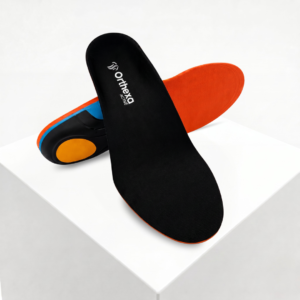
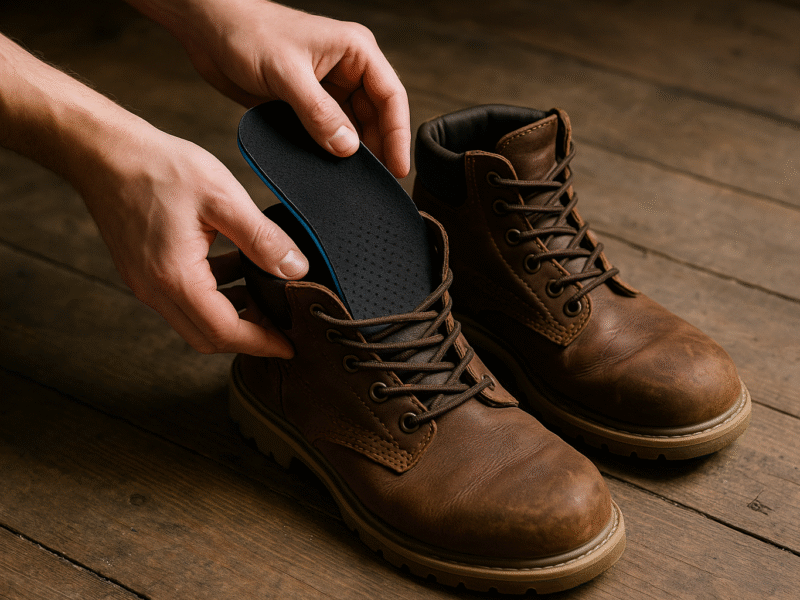
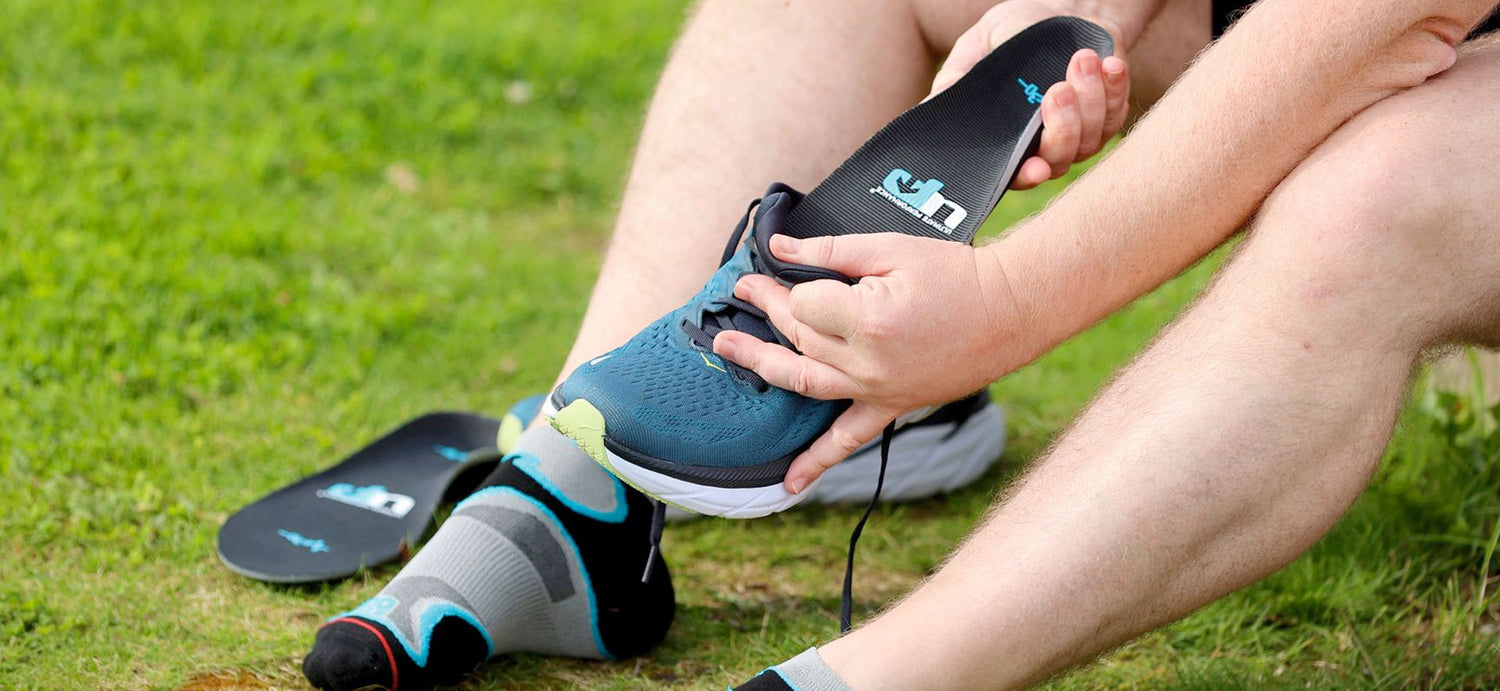
Designed for runners are Shoe insoles – Active, which add cushioning and arch support during training. For everyday use outside running, a basic option may be sufficient, such as Shoe insoles – Comfort. You can view the complete range in the shoe insoles category.
When to see a doctor
This article is for informational purposes and is not a substitute for a medical examination. Seek medical care if the pain worsens rather than improves while running, is present at rest or at night, is accompanied by marked swelling or bruising, causes tingling or numbness, or does not improve after a few weeks of reduced loading. These signs may indicate a stress fracture or another more serious injury that could be worsened by continuing to run.
Frequently asked questions
Can I run with heel pain?
Running is not recommended if the pain is sharp or increasing. Ignoring it can turn a mild problem into a chronic one or, in the case of a stress fracture, a more serious injury. Choose low-impact activities such as swimming or cycling while you recover.
How can I distinguish ordinary plantar fasciitis from a stress fracture?
Plantar fasciitis is worst with the first steps in the morning and often eases during a run. A stress fracture gradually worsens during a run, does not improve after warming up, and may hurt even at rest in more advanced cases. These signs call for a medical evaluation.
Will insoles get rid of my pain?
Insoles may reduce the load on the heel and improve comfort, but they do not address the underlying cause when it is a rapid increase in training. The most reliable long-term approach combines a gradual return to your usual mileage, suitable footwear, and insoles for additional support if needed.
How long does recovery take?
It depends on the cause and how consistently you reduce loading. Mild plantar fasciitis may take a few weeks, while a stress fracture typically requires 6 to 8 weeks of complete rest from impact loading. Patience and a gradual return to running are essential.
Conclusion
Heel pain when running is often caused by plantar fasciitis or Achilles tendinopathy, but it may also involve a heel spur, heel fat pad atrophy, Sever’s disease in young athletes, or, in rarer but more serious cases, a stress fracture that can be worsened by running. Once the cause has been identified, the next steps may include a gradual return to mileage, suitable footwear, and supportive insoles if needed. Listen to your body: an extra rest day is a smaller cost than an injury that stops you from running for months.
From our store