
Benefits of walking: 8 reasons to walk every day
Walking is one of the most accessible forms of physical activity. Research has associated about 30 minutes a day with up to a 19% lower risk of coronary heart disease, better blood glucose control, and greater creativity. Walking is free, requires no special equipment, and is easy to begin.
Below are eight benefits of walking supported by published research, followed by a section on what may make a morning walk useful. You will also find guidance on choosing shoe insoles if you walk frequently.
How much walking do we need?
The World Health Organization (WHO) recommends that adults get at least 150–300 minutes of moderate-intensity aerobic activity each week, and walking can count toward that total. This is equivalent to roughly 20–40 minutes a day, although it can also be divided into shorter walks. Smaller amounts are still worthwhile, and doing more can provide additional benefits.
Source: WHO: Guidelines on physical activity and sedentary behavior.
What are the main health benefits of walking?
Walking affects several aspects of health, from cardiovascular fitness to mood. The following eight benefits are supported by published research.
1. It burns calories
Walking uses energy and can support weight maintenance or weight loss. The number of calories used depends on your walking speed, the distance, the terrain, and your body weight. Walking uphill generally uses more energy than walking on level ground.
2. It supports heart health
A meta-analysis of 11 long-term studies involving more than 295,000 participants found that walking for about 30 minutes a day, 5 days a week, was associated with a 19% lower risk of coronary heart disease (95% confidence interval: 14–23%). Longer duration or distance was associated with a further reduction in risk.
Source: meta-analysis in the European Journal of Epidemiology.
3. It can help regulate blood glucose
A short walk after a meal may help lower blood glucose. In a controlled study of older adults at risk of impaired glucose tolerance, a 15-minute walk after each meal controlled post-dinner blood glucose more effectively than one 45-minute walk in the morning or afternoon. If it suits you, try adding a short walk after your main meals.
Source: DiPietro et al., Diabetes Care (2013).
4. It supports the joints and strengthens leg muscles
Walking strengthens the muscles around the knees and hips, which help support the joints, as well as other muscles throughout the legs. Hills or a treadmill incline can add more resistance. For information about movement and other measures for joint wear, read our guide to managing osteoarthritis symptoms naturally.
5. It is associated with fewer respiratory illness days
A study of more than 1,000 adults found that those who performed aerobic activity, such as regular walking, on at least 5 days a week had 43% fewer days with cold or flu symptoms than less active participants. When they did become ill, their symptoms were milder on average.
Source: Nieman et al., study of physical fitness and respiratory infections.
6. It may improve mood
A research review found that aerobic activity, including walking, can reduce anxiety, depression, and negative mood and improve self-esteem. In that review, 30 minutes of moderate activity, such as brisk walking, 3 times a week was considered sufficient to produce benefits.
Source: review article on physical activity and mental health.
7. It is associated with a longer life
A pooled analysis of more than 50,000 walkers from 11 British studies found that people who walked at an average pace had a 20% lower risk of death from any cause than slow walkers. Among people over 60, a faster walking pace was associated with almost half the risk of death from cardiovascular disease.
Source: Stamatakis et al., British Journal of Sports Medicine (2018).
8. It can encourage creativity
In a series of four Stanford experiments, walking consistently increased creative thinking. Between 81% and 100% of participants produced more creative responses while walking, and in one experiment participants generated twice as many original ideas on average as they did while sitting. If you are stuck on a problem, try thinking about it during a walk, preferably outdoors.
Source: American Psychological Association summary of research by Oppezzo and Schwartz.
What are the potential benefits of a morning walk?
Walking can be beneficial at any time of day. A morning walk also provides early light exposure, which can help regulate the circadian rhythm. Some research has associated morning exercise with better objective sleep measures the following night, and some people find a morning routine easier to maintain than an evening one.
Daytime light exposure, especially natural daylight, helps regulate the body clock. Sleep experts recommend regular exposure to daylight. Morning light may be particularly useful because it can help counter the effects of artificial light in the evening. A morning walk outdoors is a simple way to get this exposure.
Source: recommendations for daytime light exposure.
One study found that morning exercise, including walking, was associated with better objective sleep measures than the same exercise in the evening, including fewer awakenings and sleep-stage transitions. The effect was greatest among people who usually had difficulty falling asleep.
Source: study of morning and evening exercise and sleep quality.
Morning activity may also affect cognition during the day. In a study of 67 generally inactive older adults, morning exercise followed by a 3-minute walk every 30 minutes increased BDNF, a protein involved in brain function, and improved measures of working memory and executive function.
Source: study of morning exercise, movement breaks, and cognitive function.
A morning walk can also be easier to fit into an established routine. You might walk after coffee, while taking the dog out, or on the way to the bus. Scheduling it early may make it less likely to be displaced by fatigue or unexpected commitments later in the day.
Which shoe insoles should you choose if you walk frequently?
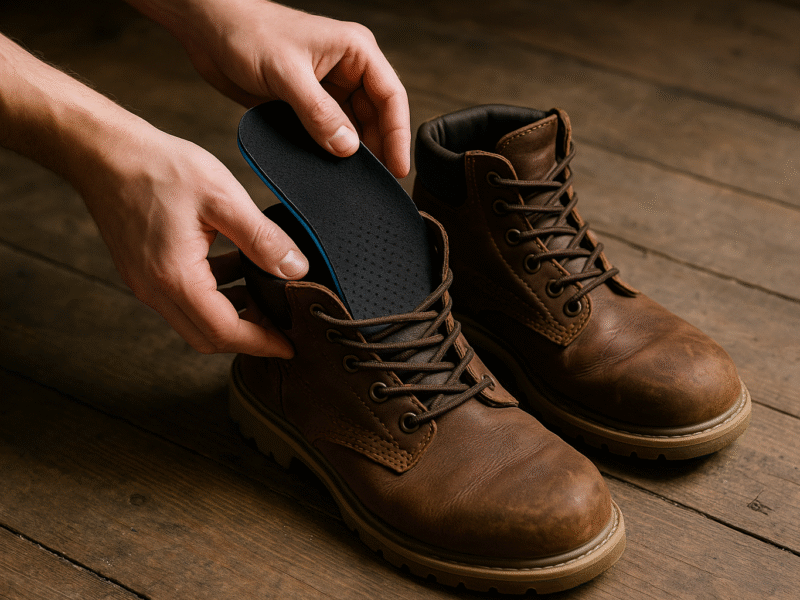
Frequent walking on asphalt or paving stones, especially in worn shoes, can place additional load on the feet, knees, and spine. Well-designed shoe insoles can distribute pressure more evenly across the foot, which may make longer walks more comfortable.
| Insoles | Best for | Key features |
|---|---|---|
| Active | Sports, running, and walking on uneven terrain | Stable arch support, pressure cushioning, and moisture management |
| Comfort | Everyday walking and spending all day on your feet | Cushioning for the heel and arch, with foot support |
| Active + Comfort set | People who walk both for recreation and at work | One pair for sports, one for everyday use, and antibacterial materials |
When should you see a doctor?
This article is for information only and does not replace medical advice. If you have cardiovascular disease, diabetes, or joint problems, talk to a doctor before increasing your physical activity. Seek medical attention if walking causes chest pain, shortness of breath that is out of proportion to the effort, or dizziness, or if pain in a joint or foot persists or gets worse.
Frequently asked questions
Is it better to walk in the morning or evening?
Both can support cardiovascular health, blood glucose control, and mood. A morning walk provides early light exposure that may help regulate the circadian rhythm and sleep, while some people find that an evening walk helps them unwind. The best time is the one you can maintain consistently.
How many steps a day are enough?
There is no single magic number. The total amount of moderate-intensity activity matters more, and the WHO recommends 150–300 minutes a week. Many people use 7,000–10,000 steps a day as a practical target, although step counts are not a direct equivalent of the WHO time-based recommendation.
Does brisk walking count more than slow walking?
A faster pace can increase exercise intensity. Research also associates faster walking with a lower risk of death than slow walking, even over the same distance, although this does not prove that pace alone causes the difference.
Will walking a lot hurt my joints?
Moderate walking does not generally wear out the joints. Instead, it strengthens the muscles that support them. If you already have joint pain, read our guide to managing osteoarthritis symptoms naturally.
How can I walk more when I have little time?
Short walks throughout the day contribute to your activity total and can be easier to fit in than one long walk. For practical ideas, see our article 10 ways to move more.
Walking is a healthy habit that does not require a gym, expensive equipment, or specialist knowledge. Start at a pace that feels comfortable and gradually increase the length of your walks.
From our store

Active sports insoles