Is sleeping on your stomach bad?
Sleeping on your stomach is considered the least advisable sleep position: it keeps your neck turned at nearly a right angle through the night and strains the lumbar spine. It can reduce snoring for some people, so it is not necessarily the “wrong” position, but it helps to know how to limit the strain if it has been the only way you can fall asleep for decades.
Stomach sleeping is one of the least common sleep positions. Most people prefer sleeping on their side or back, and for good reason. This article explains why the position strains the body, when it may still be a reasonable choice, and what you can do if you do not want to or cannot give it up.
Why does sleeping on your stomach strain your neck and back?
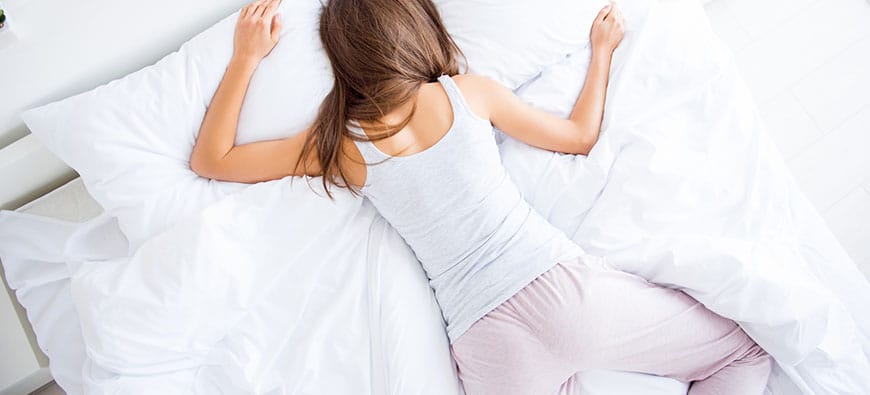
Sleeping on your stomach strains the body in two places at once: the neck remains turned to one side, while the weight of the chest and abdomen pushes the lumbar spine into an excessive curve. Both move the spine away from its natural, neutral alignment.
When you lie on your stomach, you have to turn your head to one side to breathe. Your neck stays in this rotation throughout sleep, which Cleveland Clinic says extends the neck backward and compresses the spine, increasing the risk of neck, back, and shoulder pain.1 At the same time, the weight of the torso causes it to sink deeper into the mattress, flattening the spine’s natural curve and placing additional strain on the lower back.1 If neck pain affects you regularly and not only after a night spent on your stomach, also read about cervicalgia and when it is more than simply a stiff neck from sleeping awkwardly.
How strong is the evidence? A systematic review of six studies on sleep position and lower-back pain (Musculoskeletal Care, 2025) found that stomach sleeping is associated with a greater risk of lower-back pain because of the strain it places on the lumbar region, while sleeping on the back supports the spine’s natural alignment.2 This was a review of observational studies rather than controlled clinical trials, so it is more accurate to describe an association than a proven cause. The proposed mechanism, involving a rotated neck and compressed lower back, is nevertheless consistent and plausible.
A study of patients with chronic lower-back pain found a similar pattern: 42% said they avoided sleeping on their stomach because it caused pain, the highest proportion for any position, compared with about 15% for side sleeping.3 Because this was a cross-sectional study of people who already had lower-back pain, it does not prove that stomach sleeping causes pain in everyone. It does show that this position is the least well tolerated among people whose lower backs already hurt.
Does sleeping on your stomach have any benefits?
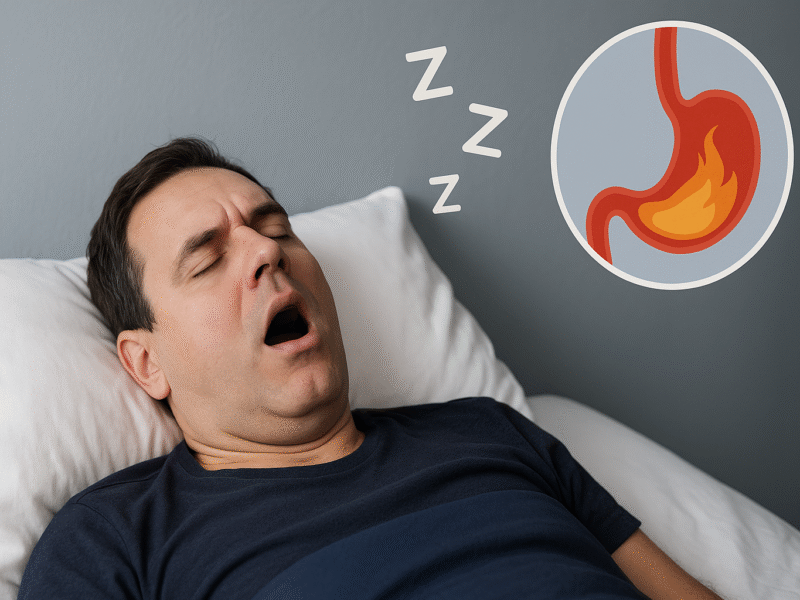
Yes, for snoring. Because sleeping on your stomach keeps the airway more open than sleeping on your back, it can reduce snoring for some people. This is the only substantial benefit of the position, so there is no need to feel guilty if this is why it suits you best.
It is not the only option, however. In clinical practice, side sleeping is the standard recommended form of “positional therapy” for mild snoring and mild obstructive sleep apnea. The main aim is to avoid sleeping on the back, where the airway is most likely to collapse.5 Because side sleeping does not require a rotated neck or compressed lower back, it is a more comfortable long-term alternative to stomach sleeping for many people. Read more about the benefits of side sleeping in our separate article. If you snore loudly and regularly or have pauses in breathing, changing position alone is not a treatment. See the “when to see a doctor” section below.
How can you reduce strain if you cannot stop sleeping on your stomach?
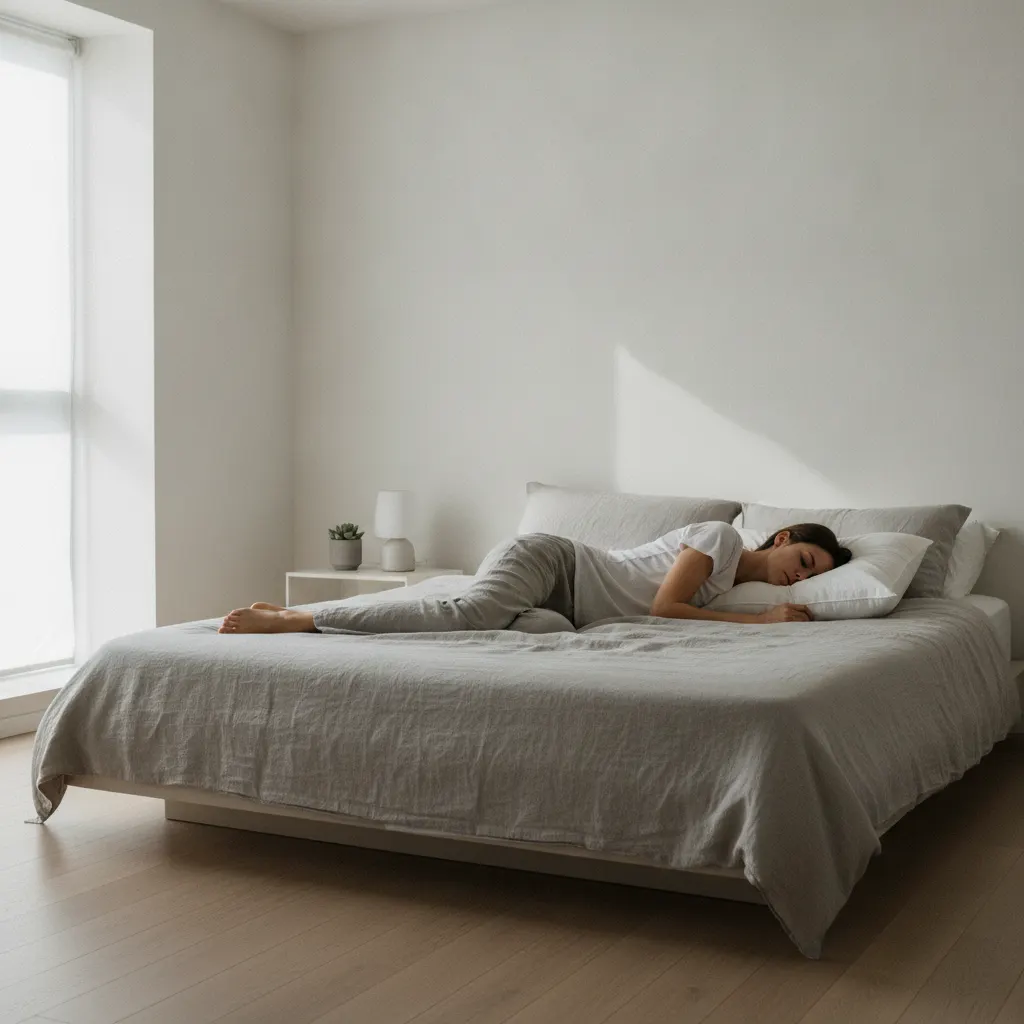
If you have slept on your stomach for decades and know that other positions do not work for you, a realistic goal is to reduce the strain rather than change the habit overnight. Two simple measures make the greatest difference in keeping the neck and lower back more closely aligned.
- Use a very thin pillow under your head, or no pillow. The thicker the pillow under your head, the more your neck has to rotate and tilt backward. Mayo Clinic advises using a pillow under your head only if it does not place additional strain on your neck and back. In practice, this means choosing the thinnest possible pillow so your head lies close to the mattress.4
- Place a thin pillow under your pelvis or abdomen. Mayo Clinic recommends placing a pillow under the hips and lower abdomen to reduce pressure on the back by preventing the pelvis from sinking too deeply into the mattress.4
A conventional thick, contoured pillow is not suitable for stomach sleeping, even if it is otherwise a high-quality pillow. Such pillows are designed to support the neck when lying on your side, but on your stomach they raise the head further and worsen the rotation. The rule for this position is therefore the opposite of the rule for side or back sleeping: less is more.
How can you switch to sleeping on your side?
The transition is possible, but it is a gradual process rather than a one-time decision. The body usually takes several weeks to unlearn the habit of stomach sleeping. The most effective approach is to make it physically difficult to return to the old position.
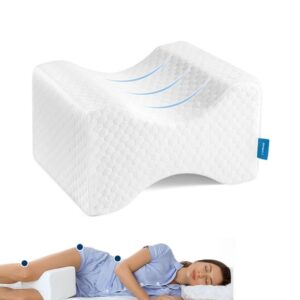
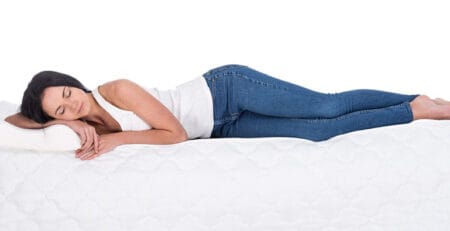
One practical approach is to place a support beside your body on the side toward which you usually roll back onto your stomach. Use a long body pillow, a firmer cushion, or a folded blanket. Cleveland Clinic describes such a pillow as a “bumper” that prevents an unconscious turn back onto the stomach without waking you.1 For support between your knees, you can use an ErgoPlus knee pillow, which helps keep your hips and pelvis aligned while you lie on your side and makes side sleeping more comfortable as you adjust to it.
Once you consistently fall asleep and remain on your side, it makes sense to consider a suitable pillow for that position. Unlike stomach sleeping, a thicker, more contoured pillow can be useful because it fills the space between your shoulder and head and keeps your neck aligned with your spine. Memory contoured pillow is designed for this purpose when sleeping on your side, but it is not suitable while you still sleep mostly on your stomach, when it would be used at the wrong height and in the wrong position. For general help choosing a pillow, read our pillow selection guide, and find the full range in our pillow category.
| Position | Effect on the neck and back | Effect on snoring |
|---|---|---|
| On the stomach | Neck rotated, lower back strained | May reduce it |
| On the back | Most neutral spinal position | May make it worse |
| On the side | Neutral alignment with proper support | May reduce it |
When should you see a doctor?
This article is for information only and does not replace a medical examination. Seek medical care if morning neck or lower-back pain does not ease during the day, if you experience tingling or numbness in your arms or legs, or if your partner notices loud snoring with pauses in breathing. The latter may be a sign of sleep apnea, which cannot be resolved by sleep position alone.
Frequently asked questions
Do I need to stop sleeping on my stomach immediately?
No. If the position is comfortable and you have no pain, there is no urgent reason to change. If you feel stiff in the morning or have neck or lower-back pain, first try the measures that reduce strain and, if needed, gradually transition to side sleeping.
Why does my neck hurt on only one side after sleeping on my stomach?
Because you turn your head to the same side for most of the night, the strain is one-sided. Try consciously alternating the side toward which you turn your head, or spend less time in this position.
Is sleeping on your stomach safe during pregnancy?
It becomes physically uncomfortable and impractical in the later months of pregnancy; earlier on, comfort is the main consideration. Ask your obstetrician or gynecologist for advice specific to your trimester.
Does a thicker mattress help with stomach sleeping?
Firmness, rather than thickness, is what helps. A medium-firm to firm mattress prevents the torso from sinking too deeply, which reduces excessive curvature of the spine.
From our store
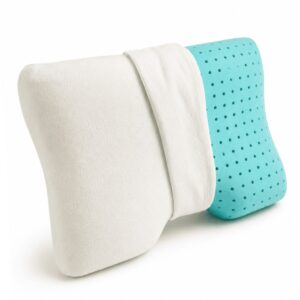
MEMORY Contoured Pillow