
Sitting Posture: What Actually Helps With Pain
Poor sitting posture was long assumed to cause back pain, but research does not clearly support that claim. More important than one “correct” position is changing position often, supporting the lower back, and keeping the feet supported. Below, we examine what the evidence says about posture and what actually helps during prolonged sitting.
Does poor posture really cause back pain?
Research does not confirm a direct causal relationship between “poor” posture and back pain. A broad review that brought together 41 systematic reviews of posture and physical workload at work, published in the Journal of Biomechanics, found no consensus that posture causes lower back pain. Associations were reported but were inconsistent, particularly in higher-quality, long-term prospective research.
Cambridge University Hospitals in the UK states the point even more directly in its patient information for persistent pain: there is no clear evidence that poor posture causes pain in the back or other joints , and there is no single perfect posture. How long you remain in one position matters more than which position you choose. When pain is already present, posture can influence how it feels: prolonged sitting, bending, and twisting may aggravate discomfort because muscles and soft tissues become tired, not because the spine is being damaged.
What actually helps while sitting?
Instead of searching for the “correct” posture, change position regularly. The UK NHS recommends changing position every 20–30 minutes. The spine is made to move, so varying your posture is generally more helpful to back tissues than holding one apparently “correct” position.
- Sit back against the backrest rather than at the edge of the chair. Let the backrest support you so your back muscles can relax instead of holding you upright continuously.
- Keep your feet supported , either flat on the floor or on a footrest, with the knees at approximately hip height.
- Position the screen at about eye level so you do not bend your head forward. For a step-by-step guide to setting up your desk, chair, and screen, see our article on home-office ergonomics.
- Stand up and stretch at least every half hour. Cleveland Clinic recommends taking a short walk about once an hour when possible.
If you want a chair that supports these habits, see our guide to ergonomic chair adjustments. For a specific set of movements to do after each hour of sitting, see our separate article with 5 stretches after each hour of sitting. We discuss the broader health effects of prolonged sitting, beyond the back alone, in our article about prolonged sitting.
Can a seat cushion correct your posture?
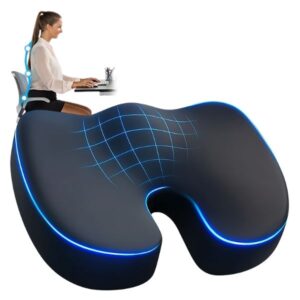
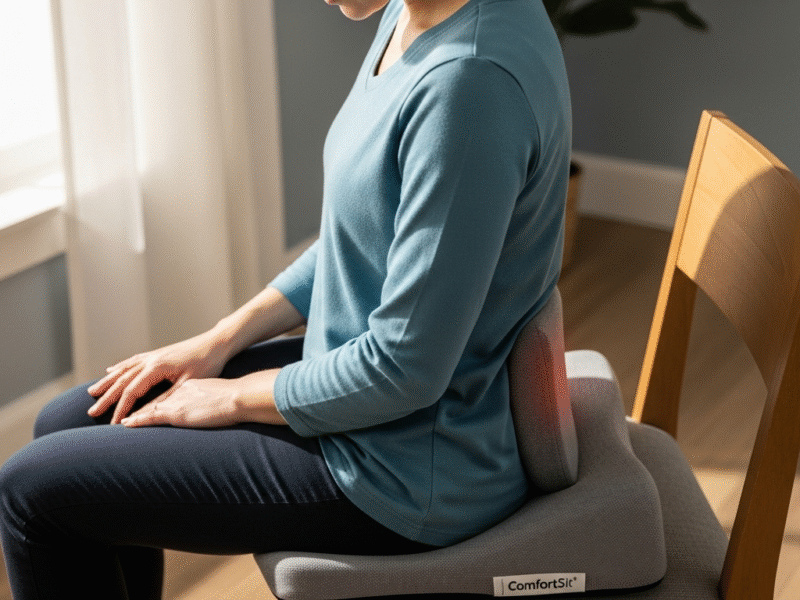
A lumbar support or seat cushion does not “correct” posture or cure back pain. Its role is comfort. It can make sitting easier to tolerate because you do not have to consciously hold the lumbar curve or sit rigidly upright without support, which Cambridge University Hospitals notes can itself be uncomfortable.
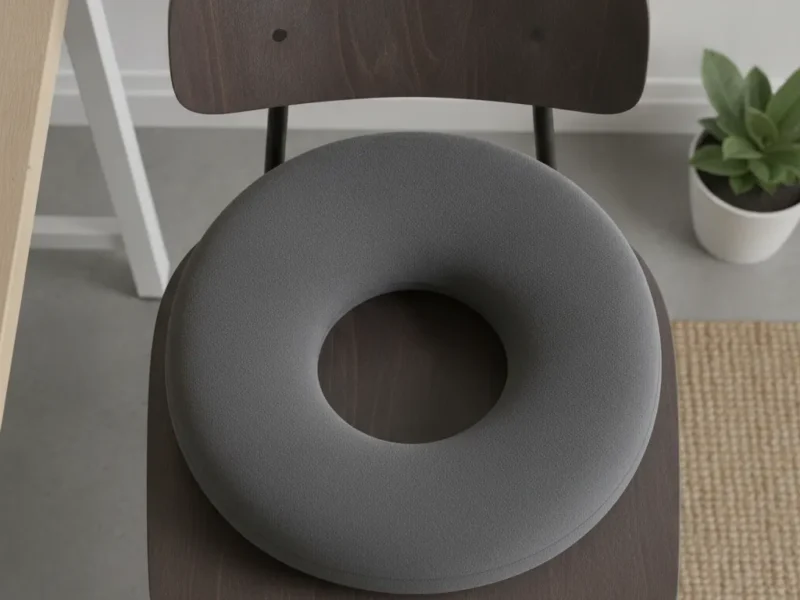
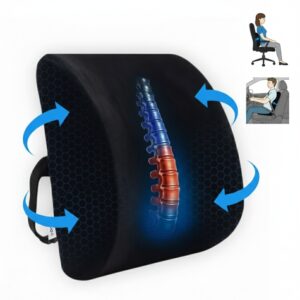
Designed to support the lower back while sitting is the Back support cushion – Lumbaris, which attaches to the backrest of a chair. Seat cushion – ComfortLux is intended mainly to cushion the sitting bones and tailbone during prolonged sitting. Both are also available in the Lumbaris + ComfortLux set. Neither creates a “correct” posture for you, but they may make sitting more comfortable.
What does the evidence say about posture correctors?
Wearable “posture correctors,” such as straps that pull the shoulders back, can serve as reminders to check and change position. A phone alarm can provide a similar reminder without a strap around the shoulders. There is no strong evidence that these devices relieve pain over the long term, so it is best to treat them as reminders rather than solutions.
If your pain is in one specific area
This article discusses sitting in general. For pronounced pain in a specific area, see our separate in-depth articles about pain between the shoulder blades and sciatica associated with sitting.
When does pain while sitting require medical care?
This article is for informational purposes and is not a substitute for consultation with a doctor or physical therapist. Seek professional care if pain is severe, does not settle after a few weeks, radiates into a leg or arm, is accompanied by tingling, numbness, or loss of strength, or occurs at night or at rest without an obvious cause. A professional can diagnose the cause and recommend an appropriate care plan.
Frequently asked questions about sitting posture
Is there one correct sitting posture?
No. According to NHS guidance and posture research, there is no single “correct” posture. How often you change position matters more than which position you choose.
How often should I change position while working?
Shift position every 20–30 minutes, and at least once an hour stand up and walk or stretch.
Can a seat cushion eliminate back pain?
Not by itself. It may make sitting more comfortable and tolerable, but it does not treat the cause of pain. Persistent pain requires assessment by a doctor or physical therapist.
Is bending my head toward the screen dangerous?
Holding any position for a long time, including a forward-bent head position, can tire muscles and increase discomfort. The practical approach is to place the screen at eye level and change position regularly rather than trying to hold a “perfect” neck posture.
More comfortable sitting comes from movement, useful support, and paying attention to your body rather than searching for one perfect posture.
Related: posture correctors and exercises.
Related: back stretches after sitting.
From our store
LUMBARIS Back Support Cushion