Back stretchers: use and safety at home
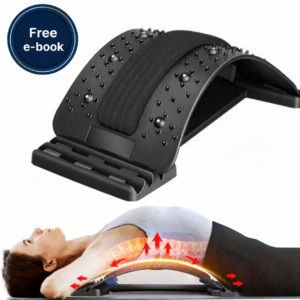
A back stretcher is a curved support placed beneath the lower back while lying down. It puts the lumbar spine into extension and may feel like a brief stretch. It has not been shown to decompress discs, increase space between vertebrae, treat sciatica, or repair spinal damage.
This guide explains what a back stretcher does, why “decompression” claims are misleading, who should avoid it, how to try one cautiously, and when back pain needs medical assessment.
What is a spinal stretcher and how does it work?
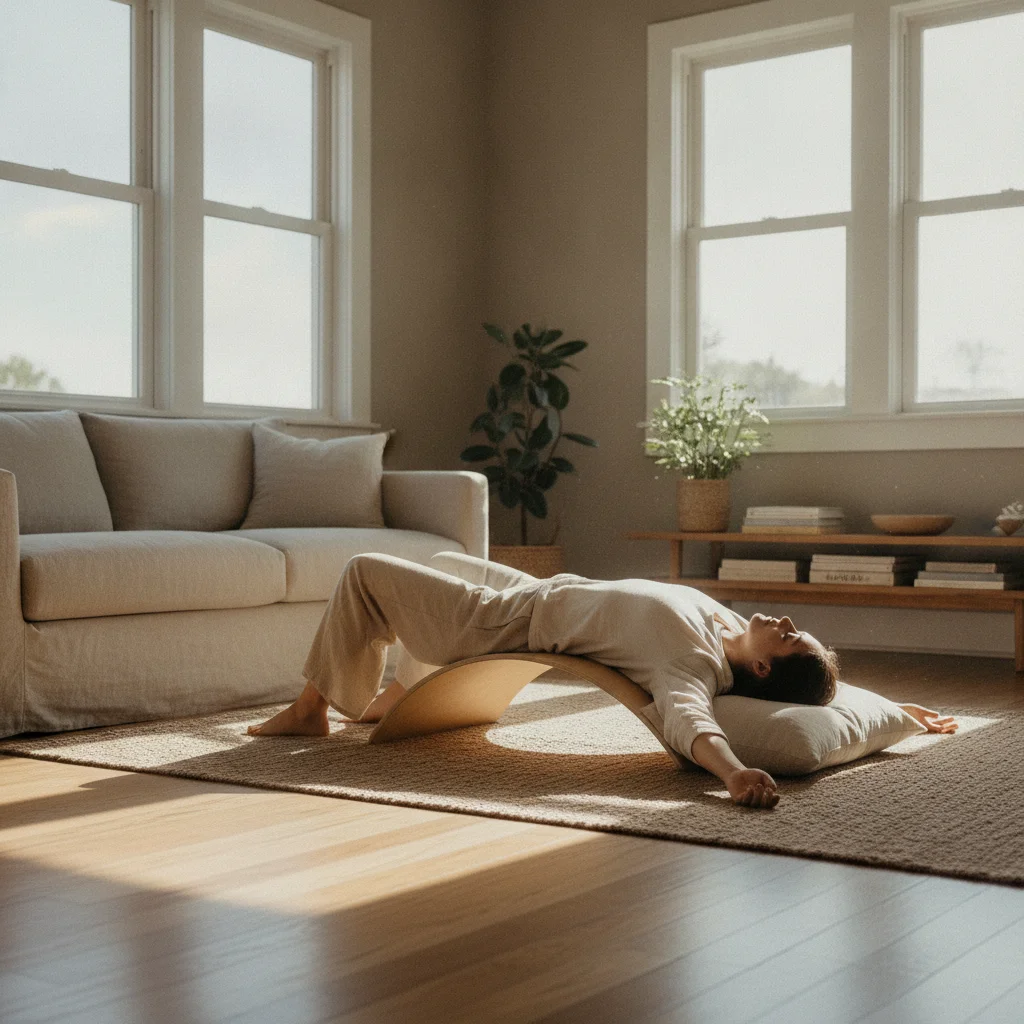
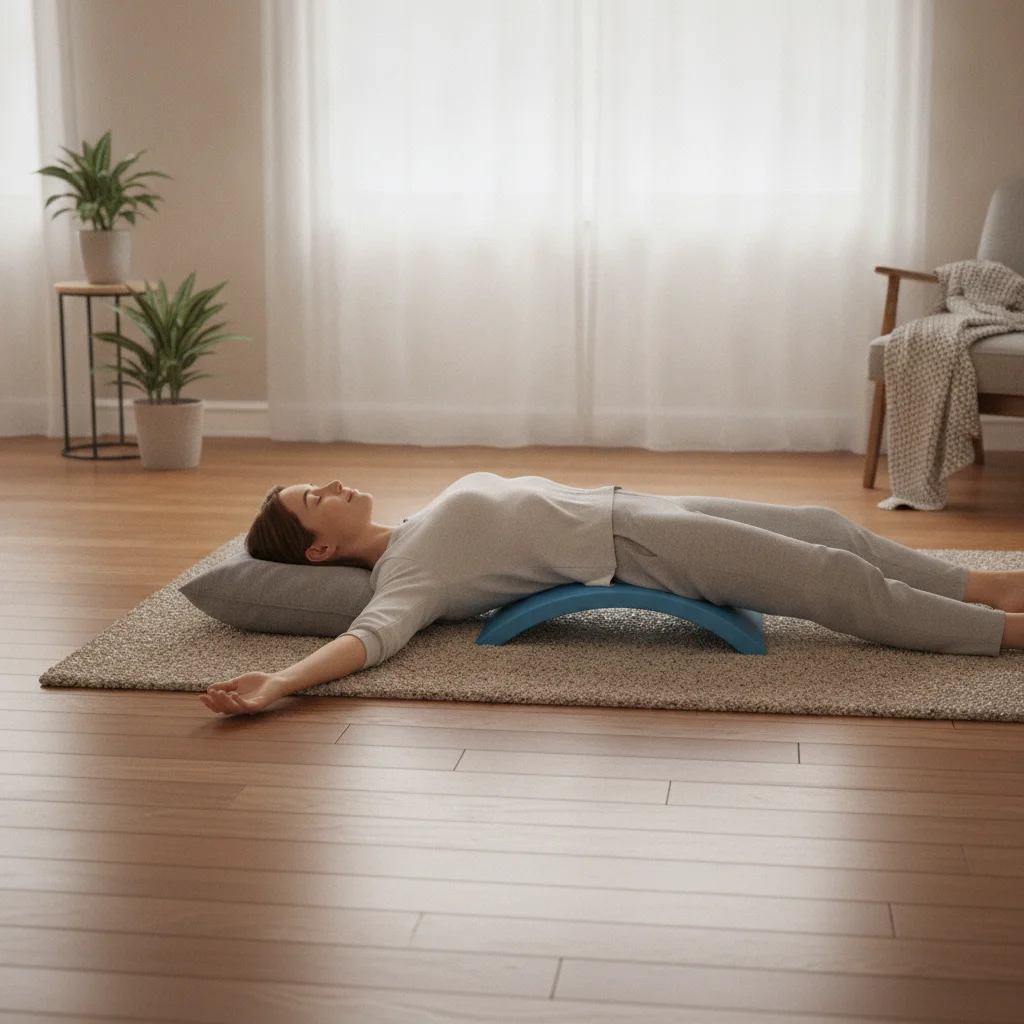
A back stretcher is a curved support placed beneath the back while lying down. It moves the lower back into extension, the opposite direction from a slouched sitting position. Some people find this position relaxing, but the device does not create proven spinal decompression.
In marketing, “spinal decompression” often refers to a feeling of stretch or reduced pressure. A home arch does not have evidence showing that it increases space between vertebrae or unloads discs. It is also different from clinical mechanical traction, which applies a measured external force.
Interest in these products is understandable because lower-back pain is common. The UK NHS notes that back pain, especially in the lower back, is very common and often improves within a few weeks. The MSD Manual adds that lower-back pain becomes more common with age and affects more than half of people over 65. These facts do not establish that a back stretcher is effective.
Does a back stretcher work?
It may provide a brief change of position or a comfortable stretching sensation for some people. Evidence does not support claims of lasting “decompression” or treatment of spinal disorders. Clinical traction has generally not shown meaningful benefit for ordinary lower-back pain.
A comfortable sensation is a personal response, not proof of healing or structural change. Extension can also worsen symptoms for some spinal conditions. Merck Manual states that spinal braces and traction are not helpful for ordinary lower-back pain and that traction may delay recovery. A curved home support is not identical to traction, but this evidence does not support claims that it can “fix” a disc or resolve sciatica.
A back stretcher offers a brief position change and may provide a comfortable stretch. The table separates those limited uses from unsupported treatment claims:
| What a back stretcher may do | What it cannot be expected to do |
|---|---|
| Place the lower back in a brief extension stretch | Treat a herniated disc or sciatica |
| Provide a temporary change of position | Permanently “realign” the spine |
| Offer a break from prolonged sitting | Replace appropriate movement or rehabilitation |
| Feel relaxing to some users | Resolve the cause of chronic pain |
A back stretcher is optional and may not feel comfortable. Regular movement and condition-appropriate exercise have a stronger role in back care than passive stretching devices.
Who should avoid a back stretcher?
There is no well-established group proven to benefit. Do not use one for unexplained severe pain or neurologic symptoms. Seek professional advice first during pregnancy, with osteoporosis or a vertebral fracture, after spinal surgery or recent injury, or when a diagnosed condition makes extension painful.
You might consider a cautious trial if:
- you have mild stiffness after sitting and no warning signs;
- you want to try a brief, gentle extension position;
- the position is comfortable and does not reproduce pain;
- you treat it as optional comfort rather than treatment.
Avoid use or obtain condition-specific advice if any of these apply:
- Pregnancy: ask your maternity care professional before using a device that changes spinal position.
- Osteoporosis or known vertebral fracture: avoid loading the spine over a hard curve without medical advice.
- Severe radiating pain, numbness, leg weakness, or bladder or bowel changes: do not use the device. New bladder or bowel dysfunction, saddle numbness, or major leg weakness requires emergency assessment.
- Recent injury or spinal surgery: use it only if the treating clinician has approved it.
- A condition affected by spinal extension: ask the clinician managing the condition whether this position is appropriate. Heart disease, high blood pressure, and glaucoma are not automatic contraindications to a non-inverted arch, but individual advice may still be needed.
If you are troubled by pain radiating to the leg, first read about how to approach the problem with pinched nerves in the lower back. A stretcher should not be the first response to new radiating or neurologic symptoms.
How can you try a back stretcher cautiously?
Follow the product instructions and begin with the lowest curve for a brief comfort check. Do not increase the curve or duration unless the position remains comfortable. Stop immediately for sharp or increasing pain, pain traveling into a limb, tingling, numbness, weakness, dizziness, or breathing difficulty.
Basic precautions:
- Begin gently: use the lowest setting for a brief trial and do not force the back over the curve.
- Increase only if comfortable: follow the manufacturer’s limit; there is no universal evidence-based 5–10 minute dose.
- Breathe and relax: breathe normally and avoid forcing the position.
- Get up slowly: roll to your side before rising if that feels safer and prevents a sudden movement.
- Stop if symptoms occur: stop immediately for sharp pain, radiating pain, tingling, numbness, weakness, dizziness, or breathing difficulty.
The NHS advises people with ordinary back pain to stay active and continue normal activities as tolerated rather than remain in bed for long periods. A brief stretch should not replace movement or recommended rehabilitation.
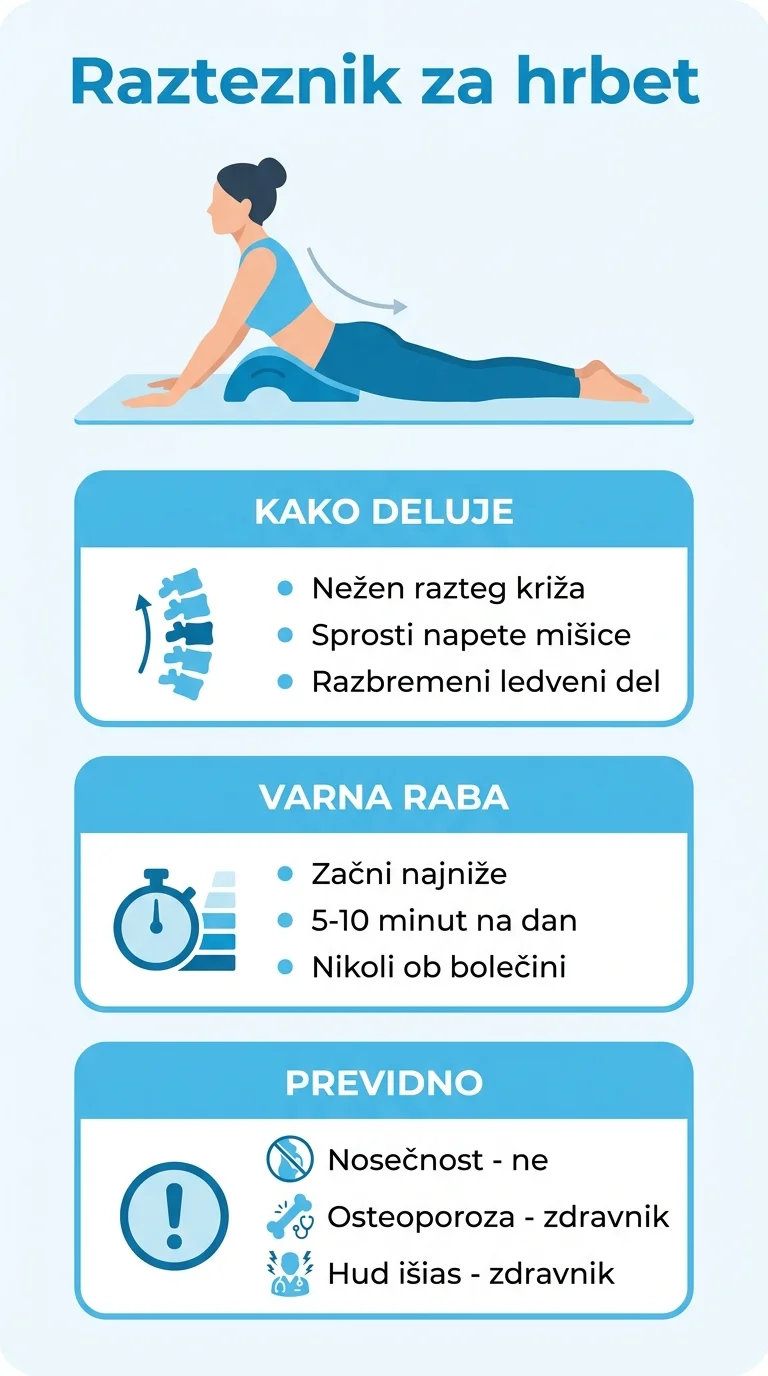
The infographic below summarizes how the stretcher works, how to use it safely, and when it is better not to, all at a glance.
How do you choose a back stretcher?
Check the product’s weight limit, stability, dimensions, instructions, and available curvature settings. The lowest setting should feel gentle, and the base should remain stable on the intended floor. More curvature does not mean better results.
What to pay attention to:
| Criterion | What to look for | Why is it important |
|---|---|---|
| Adjustability | Multiple degrees of curvature (e.g., mild, medium, strong) | Allows a cautious trial and gradual adjustment |
| Load-bearing capacity | A stated maximum user weight | Ensures the product is used within its design limit |
| Material | A smooth, undamaged surface | Avoids sharp edges or concentrated pressure |
| Size and weight | A size that supports the intended area and can be stored safely | Affects fit, storage, and transport |
| Stability | A wide, nonslip base | Helps prevent movement on the floor |
One option in our range is the BackFix back stretcher, with three curvature settings: 15°, 28°, and 42°. It is made from rigid plastic, has a stated maximum user weight of 180 kg, and is lightweight and compact. Begin at the lowest setting and follow the instructions. It does not decompress discs or treat pain; it simply places the lower back in extension for a brief stretch. Find it among our stretching aids, which includes other products for stretching and muscle relaxation.
Which habits support the back over time?
Regular movement, suitable strength and mobility work, sleep, and gradual activity are more important than any passive device. No single posture or exercise prevents all back pain, and advice should fit the condition.
The MSD Manual emphasizes regular physical activity and exercises for the abdominal, gluteal, and back muscles as part of back care. The American Academy of Orthopaedic Surgeons resource OrthoInfo advises combining aerobic activity such as walking or swimming with suitable exercises for back and abdominal strength and flexibility.
Some habits that work in everyday life:
- Strengthen the core: build trunk strength gradually with suitable exercises.
- Interrupt sitting: change position and move regularly instead of following a rigid 30–45 minute rule.
- Stay active: walking, swimming, cycling, or other suitable activity can support general fitness.
- Adjust your workspace: set up the chair, screen, and foot support for comfort and vary your position.
Comfort at work depends on fit, movement, and task variation. See our guides to ergonomics for the home office and how to improve posture while sitting. A passive device should remain secondary to appropriate activity.
For an easier understanding, also watch the video on this topic:
When should you seek medical advice for back pain?
A back stretcher is not treatment. Seek assessment for severe, persistent, worsening, or radiating pain and for any neurologic symptoms.
Contact a healthcare professional if pain does not improve after a few weeks or comes with fever, chills, unexpected weight loss, or other concerning symptoms. New bladder or bowel dysfunction, numbness around the groin or buttocks, or significant weakness or numbness in both legs requires emergency assessment. Call local emergency services immediately if symptoms are severe or rapidly worsening.
Seek urgent medical advice for:
- radiating pain with increasing numbness or weakness;
- new loss of bladder or bowel control or numbness around the groin or buttocks;
- pain after a significant fall, impact, or traffic collision;
- the pain is accompanied by fever, chills, or unexplained weight loss,
- pain that persists for several weeks or continues to worsen.
The content is for informational purposes and does not replace a consultation with a doctor. For prolonged or severe pain, pain radiating to the leg, or neurological signs, consult a doctor or physiotherapist before using the stretcher.
Frequently asked questions about the back stretcher
Can a back stretcher treat sciatica?
No. It does not treat the cause of sciatica. Radiating pain with tingling, numbness, or weakness should be assessed before you try a device that places the back in extension.
How long should I lie on the stretcher?
There is no universal evidence-based duration. Start with the lowest setting for a brief comfort check and follow the product instructions. Stop for sharp or radiating pain, tingling, numbness, weakness, dizziness, or breathing difficulty.
Does a spinal stretcher work?
It may provide a comfortable position change for some users, but evidence does not support lasting “decompression” or treatment claims. Clinical traction has generally not proved helpful for ordinary lower-back pain.
Who is not suitable for a spinal stretcher?
Avoid use with a known vertebral fracture, severe osteoporosis, recent spinal injury or surgery unless cleared, or neurologic warning signs. Ask your maternity care professional during pregnancy. People with a diagnosed condition should obtain advice specific to that condition.
Does the stretcher replace back exercises?
No. A back stretcher is optional and passive. Regular activity and condition-appropriate rehabilitation have a larger role in back care.
From our store