
How Often Should You Replace a Pillow? Signs and Tips
A pillow should generally be replaced every 1 to 2 years . This general recommendation reflects how filling compresses and loses support over time while sweat, oils, and dust accumulate and provide food for dust mites. If you wake with neck pain, your pillow remains flat after folding, or your allergies worsen, it may have exceeded its useful life. Below are specific signs, a quick home test, differences among materials, and tips for keeping a pillow in good condition for longer.
How often should you replace a pillow?
Cleveland Clinic recommends replacing most pillows within one to two years . Dr. Brian Chen, a sleep specialist at the clinic, explains that material breaks down over time and no longer provides the same support it did when new.[1] This is a general guideline rather than a strict deadline. A well-made pillow of durable material may last longer, while inexpensive synthetic fill may lose its shape within a year. What the pillow shows matters more than the calendar, so check the signs of wear in the next section.
What signs indicate that it is time for a new pillow?
Some signs are visible or easy to feel, while others appear only when you wake in the morning. Consider replacement if you recognize one or more of the following:
- Lumps or a permanent indentation: the filling has compressed unevenly, leaving a hollow where the head rests even when no pressure is applied.[1]
- Waking with neck pain or a headache: this may indicate that the pillow no longer holds the neck and spine in a neutral position, causing the muscles to remain tense overnight.[1]
- Constant fluffing and reshaping: if you repeatedly shake or bunch the pillow during the night to restore its shape, the filling may have lost volume or resilience.
- Visible stains or a persistent odor: yellowish sweat and oil stains that washing does not remove indicate buildup deep in the filling.
- Worsening allergies at night or in the morning: a stuffy nose, sneezing, or itchy eyes that ease when you leave the bedroom may be associated with dust mites in bedding. See the allergen section below.
The fold test: check your pillow in less than a minute
Fold the pillow in half as though packing it in a suitcase, then release it. If it quickly returns to its original shape, it is still resilient. If it stays folded or unfolds only very slowly, it has lost elasticity and may need replacement.[1] This test may be useful for synthetic and foam fills. For feather pillows, also check whether shaking distributes the filling evenly through the cover or leaves empty pockets.
How does pillow lifespan vary by material?
The basic 1-to-2-year guideline is a general average. Actual durability depends mainly on the density and quality of the filling. Denser materials such as latex and high-quality memory foam compress more slowly and retain their shape longer, while inexpensive synthetic fill flattens sooner:
| Pillow material | Approximate lifespan |
|---|---|
| Synthetic fill (polyester) | about 1–2 years |
| Memory foam | about 2–3 years |
| Latex | about 3–5 years |
| Feather or down (with regular care) | about 2–4 years |
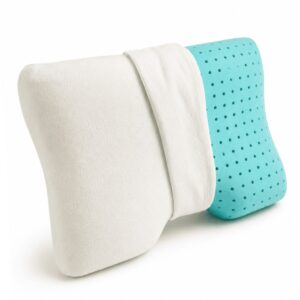
These are approximate practical ranges rather than strict rules. Manufacturing quality and care, discussed below, affect actual lifespan more than material alone. If you want a pillow designed to retain its shape, see the Memory contoured pillow, or read our more detailed review in the article Memory Foam Pillows: Are They the Best Choice for Your Neck?
Why do old pillows accumulate dust mites and other allergens?
Each night, sweat, dead skin cells, and oils remain on a pillow and provide food for dust mites. A joint clinical guideline from the US allergy organizations AAAAI and ACAAI identifies bedding, including pillows, as an important reservoir of dust-mite allergens in the bedroom. Mite waste is a common trigger for allergic rhinitis and asthma, and allergens can remain active long after mites die, allowing them to accumulate over time.[2] You can find more information about allergies and their management from the Slovenian National Institute of Public Health (NIJZ).
If allergies mainly worsen at night, see also our guide Looking for a Pillow for Allergies? What to Consider.
How can you extend the life of a pillow?
You cannot avoid replacement indefinitely, but a few simple habits may delay it:
- Use a washable protective cover: it acts as a barrier between you and the filling, catching sweat, oils, and some allergens before they penetrate deeper. For the Memory pillow, an additional washable cover.
- Wash bedding weekly: the same AAAAI/ACAAI guideline recommends weekly washing and notes that high water temperature is not necessary to reduce mite numbers. Regular washing matters more than hot water, which may present a scalding risk.[2]
- Wash or clean the pillow according to the manufacturer’s instructions: synthetic fill and feathers can often be machine washed on a gentle cycle, while memory foam and latex should be spot cleaned with a damp cloth because water and spinning can damage them.
- Air it regularly: leave the pillow uncovered for a few minutes each morning, ideally near an open window, so excess moisture can dry before making the bed.
When should you see a doctor?
Replacing a pillow and caring for bedding may help with mild neck or shoulder pain related to sleep and occasional allergy symptoms. Speak with a doctor if neck pain does not improve after replacing the pillow, radiates into an arm, or is accompanied by tingling, numbness, or weakness, or if allergy symptoms interfere with breathing. This article is for informational purposes and is not a substitute for medical advice, diagnosis, or treatment. For persistent neck pain, see also the article Cervicalgia: When Neck Pain Is More Than “Sleeping Wrong”.
Which pillow should you choose as a replacement?
The right pillow depends mainly on your usual sleeping position. For people who wake with neck pain, one option is the Memory contoured pillow, whose shape follows the neck and may help maintain spinal alignment. If you mainly sleep on your side, see also Side Sleeping: Benefits and Proper Position. If you are unsure which type is right for you, our complete guide can help: How to Choose the Right Pillow: A Practical Guide.
Frequently asked questions about replacing a pillow
How often should you replace a pillow?
The general recommendation is every 1 to 2 years, depending on the material and manufacturing quality. Denser materials such as latex and high-quality memory foam usually last longer than inexpensive synthetic fill.
How can I check at home whether my pillow is still usable?
Use the fold test: fold the pillow in half and release it. If it quickly returns to its original shape, it is still resilient; if it remains flat, replace it.
Can I machine wash a memory foam pillow?
No. Memory foam and latex can lose their structure when machine washed and spun. Spot clean them with a damp cloth and let them air-dry completely away from direct sunlight.
Why do I wake with neck pain even after enough sleep?
Your pillow may not be keeping your neck in a neutral position, either because it has lost support with age or because its height does not suit your sleeping position.
Can an old pillow worsen allergies?
Yes. Pillows and other bedding can hold dust mites and their allergens, which may trigger or worsen sneezing, nasal congestion, and other allergy symptoms, especially at night.
Sources: [1] Cleveland Clinic – Signs You May Need a New Pillow. [2] Environmental Assessment and Exposure Control of Dust Mites: A Practice Parameter, PMC (NIH).
From our store